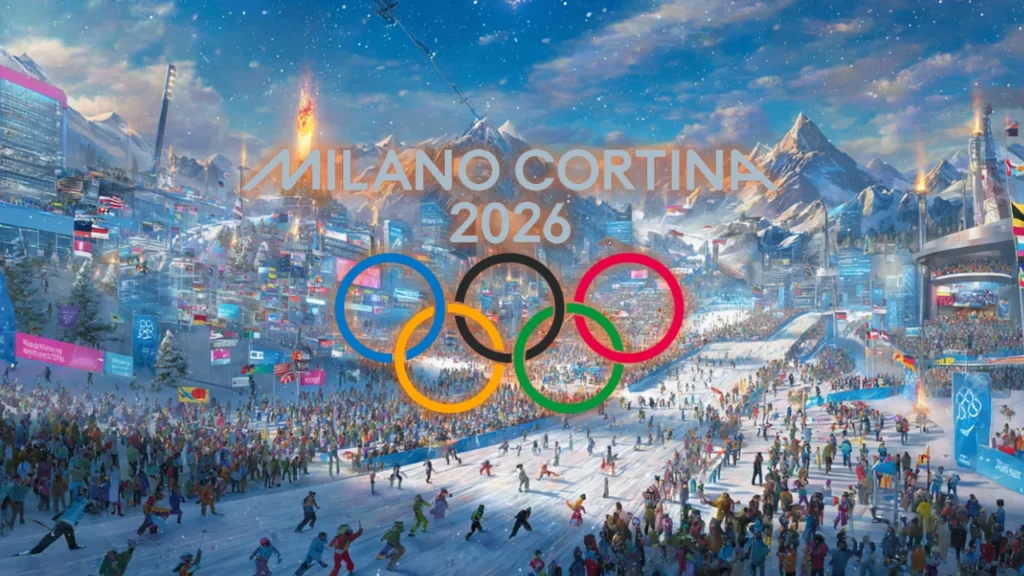
How the 2026 Winter Olympics Are Shaping Global Sport- Celebs are Ecstatic!
The Milano Cortina 2026 Winter Olympics were held across northern Italy and have finally concluded. 16 diverse sporting disciplines were organized, including alpine skiing, biathlon, bobsleigh, curling, figure skating, freestyle skiing, ice hockey, luge, Nordic combined, skeleton, ski jumping, snowboarding, speed skating, and the debut of ski mountaineering (SkiMo).
The 2026 Winter Olympics are shaping global sport depsite not having a massive audience like the Summer Games. They serve a unique purpose in promoting specific, high-skill winter sports. Public participation in winter sports fosters cultural exchanges and inspires future generations to pursue athletic development.
Numerous celebrities were spotted at the event, including Michelle Yeoh, Jean Todt, Jason Kelce, Kylie Kelce, Tom Brady, Seth Meyers, Stanley Tucci, and many more. The K-pop idol, Sunghoon from Enhyphen band, served as a torchbearer, who explained why attending these games meant so much to him. He said,
“I did figure skating for 10 years, and while training, it was always my dream to be part of the Olympics…When I was an athlete, it was my dream to showcase my performance. Now, I get to be part of the Olympics, cheering and rooting for the athletes. That still means a lot to me.” [Source]
Hosting the Winter Olympics has powerful economic benefits for the country as the knowledge and skills of its workforce are deployed in the right departments, career opportunities emerge, tourism and events industries flourish, business sector thrives, giving the region a global profile and diplomatic relations.
While there has been strong evidence that infrastructure and urban development take place in the host country during these Olympics, where major upgrades in transportation networks, housing, and sports facilities have been observed. Long-term, sustainable, and cost-effective development is promised, but comes with significant environmental consequences.
Northern Italy went to extreme lengths to make the 2026 Winter Olympics visually spectacular—drying rivers to create artificial snow and cutting down forests to carve out sleek bobsleigh tracks, as reported by The Guardian. The International Olympic Committee (IOC) was responsible for overseeing all the management of the Winter Olympics this year. Its executive director said,
“For the IOC, for sport in general, sustainability is a priority. If you want more details, the IOC can give you any amount of information about its low-carbon transport plan and how it is only using recyclable cutlery and linen tablecloths.” [Source]
But they did not unfold details about the demolition and rebuilding of existing venues, instigating a climate crisis. They did not mention the total spending on the road construction and car parking projects that are not due to be built until the Olympics were over.
Yet for the athletes, these aesthetic touches are largely irrelevant. Give them any mountain, and they will hurl themselves down it with precision and ferocity, honed through years of grueling training. For them, it’s not about perfectly sculpted tracks or soothing landscapes—it’s about the raw thrill of the sport.
Are the Winter Olympics really necessary?
Whether or not the Winter Olympics are necessary is a subject to intense debate since the risk of playing sports on ice is explicitly evident.
According to The Guardian, it is not about winning money that the players want; they don’t even hope to win a medal, and don’t have any plans to get rich after competing. It is for only one reason then,
“They come to test themselves.” [Source]
Humans have always liked the mountains, and just like George Mallory, they want to be there since they want to climb Mount Everest (because it’s there). And people come to watch them. It has nothing to do with the player’s broken leg, twisted arms, or any of them suffering PTSD for 16 months, and then somehow mustering up the courage to come back and fight.
It is a question harder to ignore as the environmental footprint of the Winter Games has become increasingly hard to justify. Traditional snow reliability is declining due to climate change. Despite pledges of “clean energy”, much of the real emissions come from indirect sources like spectator and athlete travel. And an obvious financial burden in the form of budget overruns and new infrastructure projects is raising concerns as well.
Then, how 2026 Winter Olympics are shaping global sport?
The 2026 Winter Olympics did attract global attention as the BBC reported a massive surge in streaming, with 83 million streams and record hours watched across digital platforms, as compared to 2022 figures. This shift shows global audiences are increasingly consuming elite sporting events.
Also, growing inclusivity has gradually broken traditional stereotypical mindsets. If the trend continues, then these global sports will become more diverse, truly multinational, and less dominated by a small group of nations.
Broadening of the competitive program took place with the debut of new disciplines such as ski mountaineering, aiming to stay relevant. This step reflects the evolution of athletic interests with a showcase of unique cultural roots. Global athletes will have fresh opportunities and a broader competitive portfolio.
Taken together, criticism doesn’t diminish at the games- it transforms them. Though athletic excellence has exposed tensions between ideal and reality, the essential signal pointing to global sporting events changing the future cannot be ignored. Such games are here to remain viable, relevant, and aligned with broader global values in the decades ahead; however, some adjustments are still needed.
About The Author

1 thought on “How the 2026 Winter Olympics Are Shaping Global Sport- Celebs are Ecstatic!”